BETWEEN CITY AND PARK
Olmstead and Vaux’s original plan conceived Grand Army Plaza as a public space with a clear geometry, capable of responding to the meeting of different urban fabrics and functioning as a threshold between city and park. Our proposal reinforces this essence and projects it into the present by introducing activities of the contemporary city.
The existing chaotic traffic is reorganized through a large roundabout with two concentric ellipses, separating local from express flows and providing flexibility to access points, making them more legible and navigable for drivers.
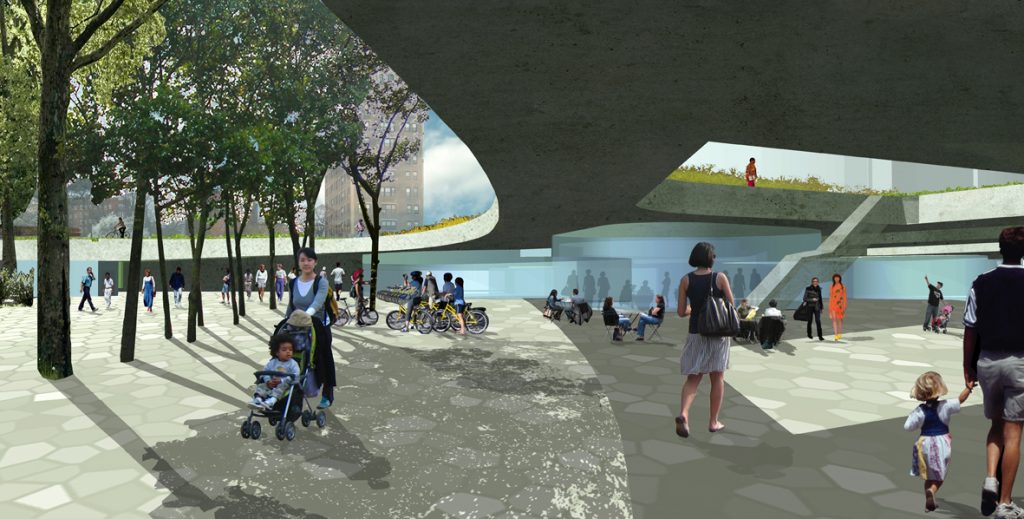
The Plaza is also envisioned as a hub for mobility and cultural and leisure activities. The subway station opens directly into the Plaza, extended by a platform that gains daylight and views towards the Memorial Arch, Bailey Fountain, the park, and its events. This transforms the site into a true intermodal node where pedestrians, bicycles, subway, and cars converge.
The existing topography is expanded with new berms that cover the express lanes and allow pedestrians to comfortably cross into the Plaza. The proposal layers different systems —pedestrian, vehicular, and subway— minimizing conflict and creating a continuous green surface that connects surrounding neighborhoods.
Beneath this landscape surface, community programs (café, bike rental, restrooms, information center) activate the Plaza. Above, the neutral plane hosts the historic elements —the Arch, the Fountain, and the trees— turning the Plaza into a major urban space capable of stitching together city and park, Brooklyn and the metropolis.


